Welcome to the Mathematical World!
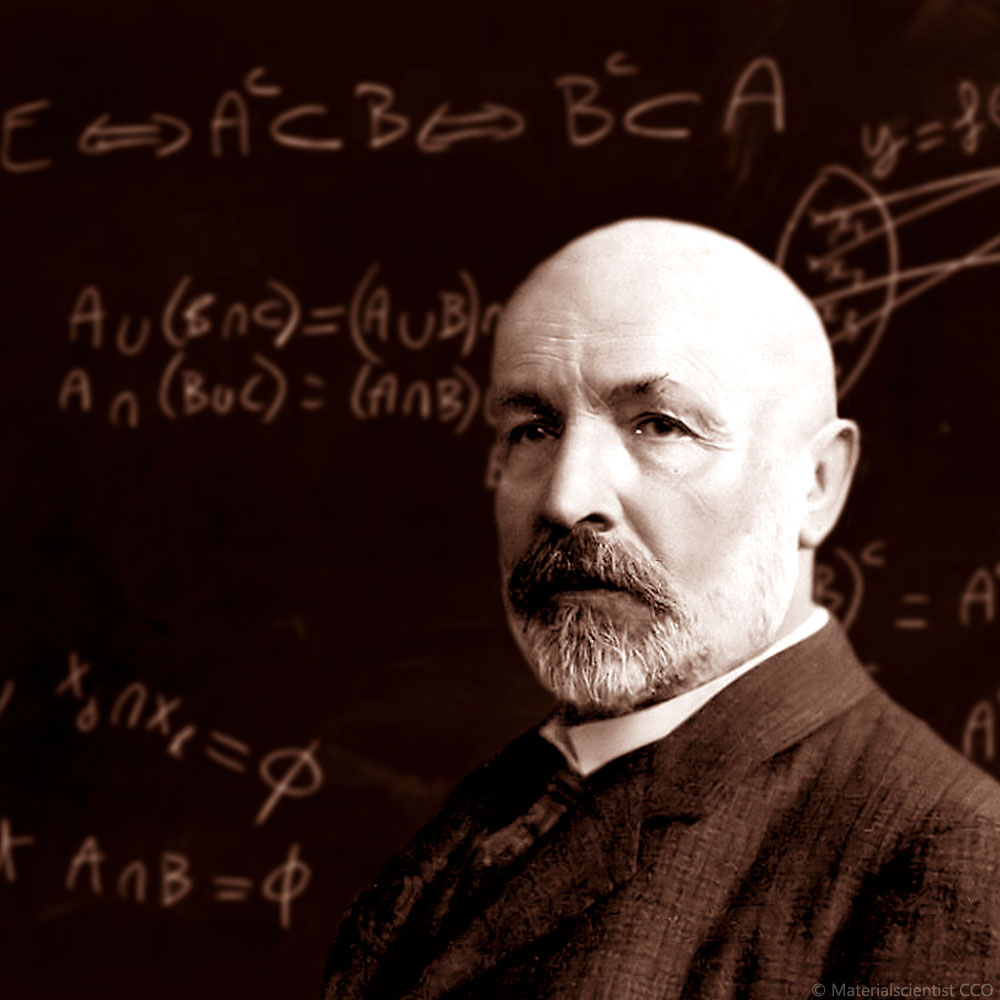
Georg Cantor
Founder of Modern Set Theory and the Theory of Infinities
Georg Ferdinand Ludwig Philipp Cantor (March 3, 1845 – January 6, 1918) was a German mathematician who revolutionized mathematics by founding set theory and introducing the concept of transfinite numbers—types of infinity that are distinct from one another. Born in Saint Petersburg, Russian Empire, Cantor spent most of his life in Germany and held a professorship at the University of Halle :contentReference{index=0}.
Countability and Uncountability
Cantor introduced the notion of one-to-one correspondence (bijection) to formally compare the size—or cardinality—of sets. He demonstrated that while the set of rational numbers is countably infinite (same cardinality as the natural numbers), the set of real numbers is uncountably infinite, meaning it cannot be matched one-to-one with the naturals :contentReference{index=1}.
The Diagonal Argument
In 1891, Cantor devised the ingenious diagonal argument to prove the uncountability of the real numbers—that no sequence can enumerate all real numbers. Briefly, given any enumeration of real numbers, one constructs a new real number differing in its decimal expansion at the diagonal positions, guaranteeing it isn't on the list :contentReference{index=2}.
Transfinite Numbers: Cardinals and Ordinals
Cantor extended the concept of numbers beyond the finite, defining:
- Cardinal numbers (\( \aleph_0, \aleph_1, \aleph_2, \dots \)) to measure the size of (possibly infinite) sets.
- Ordinal numbers to describe the order type of well-ordered sets.
This laid the foundation for arithmetic operations on infinite quantities and established a hierarchy of infinities :contentReference{index=3}.
Cantor’s Theorem and Paradox
He also proved Cantor’s theorem: for any set \( A \), its power set (the set of all subsets of \( A \)) has strictly greater cardinality than \( A \) itself. This yields an infinite ascending hierarchy of infinities :contentReference{index=4}.
He further identified Cantor's paradox: the idea that the “set of all cardinalities” cannot be itself a set, since its cardinality would then exceed itself. This paradox underscores the need for rigorous axiomatic foundations in set theory :contentReference{index=5}.
Mathematical Legacy and Controversy
Cantor's work faced strong opposition from contemporaries like Kronecker and Poincaré, who found the idea of actual infinities philosophically troubling. He endured criticism and personal struggles, including recurrent mental health issues :contentReference{index=6}.
Despite initial resistance, his theory became central to modern mathematics—forming the basis of logic, topology, measure theory, and more—profoundly influencing subsequent generations of mathematicians and scientists :contentReference{index=7}.
Honors and Final Years
Cantor received the prestigious Sylvester Medal from the Royal Society in 1904 and an honorary doctorate from the University of St. Andrews in 1912 :contentReference{index=8}. However, his final years were marked by illness and institutionalization; he passed away in a sanatorium in Halle in early 1918 :contentReference{index=9}.
LaTeX Mathematical Highlights
Here are some of Cantor’s core ideas, rendered with LaTeX:
- Diagonal Argument (uncountability of reals): \[ \forall (x_n),\;\exists x\;\text{such that }\forall n,\;x \neq x_n\;\text{(constructed by changing the nth digit of }x_n\text{)} \]
- Cantor’s Theorem: \[ \lvert A \rvert < \lvert \mathcal{P}(A) \rvert \]
Legacy
Georg Cantor transformed mathematics by rigorously defining and comparing different sizes of infinity. Despite personal hardships and intense controversy, his vision gave rise to set theory—the foundational language of modern mathematics—and expanded our understanding of the infinite. His work endures as one of the most profound and transformative mathematical achievements.

All rights reserved by the Mathematical Unity
Contact: +8801400044645
Email: mathematicalhorse1453@gmail.com
Our Discord Server: Mathematical Unity [Ulus Riyadiyat]